Solemnity of Mary Mother of God – January 1

Readings: Numbers 6:22–27 • Psalm 67:2–3, 5, 6, 8 • Galatians 4:4–7 • Luke 2:16–21
To those who have not grown up in the Catholic or Orthodox Churches, Mary seems to occupy an outsize place in the Church’s life and teaching. Of the six holy days of obligation currently observed in the United States, three are Marian: Mary, Mother of God, the Assumption, and Immaculate Conception. A fourth, Christmas, gives Mary a prominent place beside her child. The last two solemn exercises of papal authority were to confirm the dogmas of the Immaculate Conception and the Assumption. Doesn’t this seem like a mountain made out of a proverbial molehill? Pious sentimentality unmoored from Scripture, where Mary appears to have only a cameo role?
But the answer to these questions comes from Scripture’s description of Mary’s response to the visit of the shepherds: “And Mary kept all these things, reflecting on them in her heart” (Lk 2:19). In commending Mary’s contemplative attitude, Scripture suggests that some of its key truths do not lie on its surface. Some mysteries disclose themselves only to those who have attained a certain purity of heart — to those who have fasted, watched, given alms, and meditated day and night. Mary was not only such a meditator. She is also such a mystery.
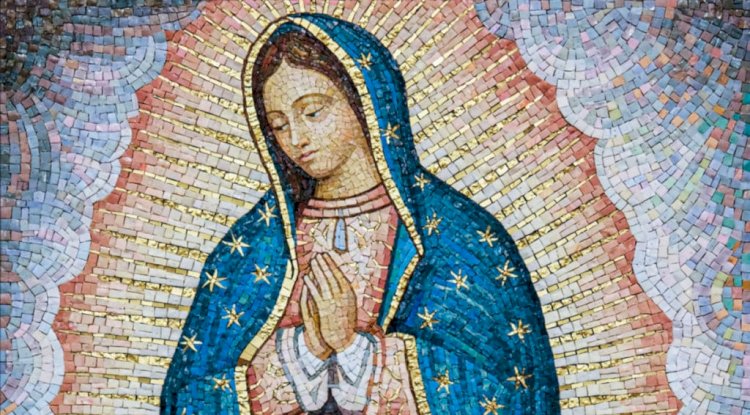
For Mary’s true greatness comes into view only for those who ponder the few descriptions of Mary found in Scripture against the background of the great pattern of redemption. Throughout the history of salvation, God has certain characteristic ways of acting. First, he doesn’t act alone. He calls servants. Second, he equips those servants whom he calls with the graces and privileges necessary for their mission. We need only think of Abraham, whom God called to be the father of a great nation, but to whom he also granted visions and covenants. We can think of Elisha, whom God called to rebuke kings, but to whom he first granted a double portion of Elijah’s spirit.
All who meditate on Mary within this broader pattern eventually come to realize that her relationship to Jesus must extend beyond mere biology. After all, even a normal human mother must provide her children with more than nutrition. To those who are body and soul, she supplies many other things besides: encouragement, love, instruction. How many more graces will a woman need to be a fitting mother to one who is not only body and soul but also divinity? Elizabeth seems to have realized this instinctively when Mary came to visit her bearing her son: “Most blessed are you among women . . . how does this happen to me, that the mother of my Lord should come to me?” (Lk 1:42–43). St. Augustine would likewise say of Mary that she “conceived in her spirit before she conceived in her womb” (Sermo 215.4). In other words, her spiritual closeness to her son, her sinlessness, her intercessory power, precede her biological closeness.
Mary’s spiritually protective and sustaining role in the life of her Son did not end with his Ascension. It continues even now in the life of the Church. The idea that God became man is a deep mystery, liable to misunderstanding in two directions. Mary, when understood as Catholic doctrine, professes her, guards against both.
The first great misunderstanding is to imagine that God became less than fully human. We know that God pervades all things. And so we perhaps imagine that God was just “in” Jesus, like He is in everything else. Perhaps He controls him like the avatar in a video game or inspires him like the other prophets. But can we say that God really “became” man? That God suffered and died for me in Christ? To these doubts, Mary provides an enduring answer: God became human enough to have a mother. This is the point the Council of Ephesus made in the fifth century when it declared Mary the theotokos. It is the point of the Letter to the Galatians when it affirms, “God sent his Son, born of a woman” (4:4).
The second and opposite misunderstanding is to imagine that Jesus is only a perfect human, a great moral teacher or mystic. But when we understood the true stature of Mary, we realize that this would be redundant. She is already sinless, perfect, exalted above the angels. Her greatness prompts us to ask, “If the Mother had such gifts by grace, then what must her Son be by nature?” Mary guards both Christ’s humanity and his divinity. She is thus rightly called, as St. John Henry Newman points out, “Tower of David.”
We do well to ask her to be a tower of strength for us as well.
What's Your Reaction?