History: Bishops of Poland And Germany Reconciled In 1965

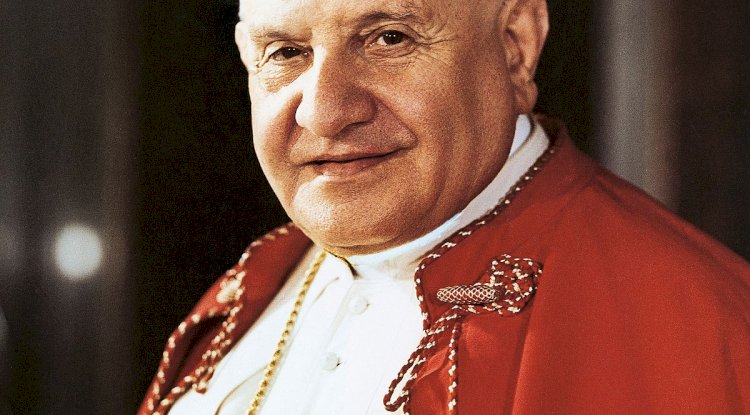
Pope John XXIII opened the Second Vatican Council in 1962, intending to adapt the Church to the contemporary world. The Polish Catholic clergy was focused at the time on a pastoral programme called the Great Novena, intended to prepare Poles in the Polish People’s Republic for the 1000th anniversary of the baptism of Poland in 1966. The programme was led by Cardinal Stefan Wyszyński, who wanted the Novena to trigger a moral change and deepen the religiousness of the Catholic congregation in this period.
It was very important for the Polish Episcopate that the celebrations be joined by as many representatives of other national episcopates as possible. This is why Polish bishops sent 56 letters to hierarchs of other nationalities in 1965. They informed the addressees about the anniversary of the Polish baptism and invited them to Częstochowa to participate in the main celebrations of the millennium on 3 May 1966.
It is in those circumstances that Polish bishops wrote an appeal to the German ones. Its main author, Archbishop Bolesław Kominek from Wrocław, was a Silesian by descent and, privately, a true promoter of reconciliation between Poles and Germans. The letter was unique because of the difficult past of both nations and was written for two main reasons. The first one was of a moral and religious nature. In the spirit of the Vatican Council, Polish bishops sought dialogue, reconciliation, and better understanding between the parties during the preparations for the celebrations in 1966. The second reason was the opening of permanent dioceses in the lands previously belonging to Germany in northern and western Poland by the Holy See. The Polish Episcopate wanted to encourage their German fellow clergymen to accept the Polish-German border set along the Oder and the Lusatian Neisse after the end of the Second World War. This was particularly difficult as German clergy had a rather negative opinion on the issue and, for a long time, did not want to accept that Poles had been victims of German aggression in 1939.
36 Polish bishops signed the letter on 18 November 1965 in Rome, including Primate Wyszyński, followed by Archbishop Kominek and Karol Wojtyła, later Pope John Paul II. The letter from Polish to German bishops did not meet with a favourable reaction from the Polish society, who still had a vivid memory of the events of the Second World War. The communist authorities used the situation to attack the Polish Episcopate and portray its acts as anti-patriotic. Unfortunately, the letter was also negatively received by German bishops from both the Federal Republic of Germany and the German Democratic Republic. Years later, however, it has been acknowledged as one of the milestones in the history of Polish-German reconciliation.
FULL TEXT OF THE 1965 LETTER
Before the Council is concluded, let us, honourable Brethren and our closest western neighbours, happily announce that the Church in Poland, together with the whole Polish nation, will celebrate the millennium of its baptism and at the same time the millennium of its state and national existence next year, the year of our Lord, 1966.
We would therefore like to officially invite you as our brothers to take part in the church celebrations of the Polish millennium. The culminating point of the Polish Te Deum laudamus will take place in the beginning of May 1966 in the Jasna Góra Monastery, dedicated to the Virgin Mary, the Queen of Poland.
Let the following disquisition be a historical and at the same time very timely commentary to our millennium, which may – with God’s help – bring our Nations even closer in our dialogue.
It is a historical fact that in 966 under the influence of his wife, the Czech princess Dobrawa, Mieszko I became the first ruler of Poland to receive the holy sacrament of baptism together with his court. From that moment on the Christian missionary work – which had already been conducted by Christian apostles in the whole Poland for generations – started to spread. The son and heir to Mieszko, Bolesław I the Brave, continued the process of Christianisation begun by his father and received Pope Sylvester II’s consent to Poland’s own hierarchy with its first metropolis in Gniezno and its three suffragan dioceses in Cracow, Wrocław and Kołobrzeg. The bishopric in Wrocław had been subordinate to Gniezno as the metropolis until 1821.
In 1000, the current Holy Roman Emperor Otto III and Bolesław I the Brave went on a pilgrimage to the tomb of Adalbert of Prague, who had died a martyr’s death while converting the Baltic Prussians to Christianity several years before. Both rulers, the Roman one and the future Polish King (Bolesław was crowned king of Poland short before his death) covered a long distance to the holy relics in Gniezno barefooted and honoured them with great piety and emotion.
The most recent German historiography gives our beginnings the following political and cultural meaning: “Through their contact with the empire of Otto the Great thousand years ago, Poland entered the Latin Christian community, and thanks to the admirable political dexterity of first Mieszko I and then Bolesław I the Brave, it became a regular member of the empire of Otto III, an empire based on the universal concept of embracing the whole non-Byzantine world, which made it substantially contribute to the shape of the eastern Europe.” This laid the basis and created the conditions for further fruitful German-Polish relations and for spreading the western culture.
Unfortunately, history shows that the German-Polish relations have not always remained that fruitful and in the past centuries turned into a kind of inherited neighbourly hostility, a topic to be discussed further in our letter (…)
Włodkowic was to some extent a classic example of the Polish thought on tolerance and freedom. His theses were directed against the German military order of the Teutonic Knights, who at that time converted the locals in the Slavonic north and the Prussian and Baltic lands with fire and sword. Over the centuries, they became a terrible and the most compromising burden for the European Christianity and its symbol, the Cross, as well as the whole Church, which they claimed to represent. Even today, after many generations and centuries, the Polish word krzyżak (Teutonic Knight) is a horrific term of abuse for every Pole and one that, unfortunately, has been too often identified with everything that is German for a long time.
The lands where the Teutonic Knights had settled later on gave birth to those Prussians who brought common discredit upon everything that is German in the Polish lands. Throughout history, they have been represented by the following names: Albert of Prussia, Frederick the Great, Otto von Bismarck and finally Hitler as the climax.
After a short period of independence (just around 20 years from 1918 until 1939), Poles – who cannot be attributed any blame for that – saw the beginning of something euphemistically called the Second World War, which we perceive as an act of total destruction and annihilation. A horribly dark night fell on our poor Homeland, a horror we had not experienced for generations. It is commonly described here as the period of the “German occupation” and known by this name in the Polish history. We were all helpless and defenceless. The country was covered with concentration camps with crematorium chimneys belching smoke day and night. More than six million Polish citizens, including especially those of Jewish descent, paid for the occupation with their lives. The leadership part of the intelligentsia was simply destroyed, and two thousand priests and five bishops (one fourth of the then Episcopate) were murdered in camps. Hundreds of priests and tens of thousands of civilians were put before firing squads at the beginning of the war (for example 278 priests in the Diocese of Chełmno itself). The Diocese of Włoclawek lost 48 per cent of its priests during the war, and the Diocese of Chełmno lost 47 per cent of its clergy. Many others were displaced. All secondary schools and universities were closed and seminaries were liquidated. Every German SS uniform not only filled Poles with utter fear but also became an object of hate towards Germans. All Polish families had to bewail someone who fell victim to the oppressors. We do not want to enumerate every painful recollection so that the still fresh wounds can heal, but if we do talk about the terrible Polish night, it is only for us and our current way of thinking to be understood more easily today. We try to forget. We hope that time, the great and diving kairos, can heal all our spiritual wounds.
Dear German Brethren, do not bear us a grudge for enumerating what happened in the recent period of our millennium. It is not meant as an accusation but rather justification of our own actions. We know very well that a huge part of the German society was under inhumane, national and socialist pressure. We know of the terrible inner torment suffered at some point by righteous and responsible German bishops, for example Cardinal Faulhaber, von Galen or Preysing. We know of the White Rose martyrs, of the resistance fighters of 20 July, of the fact that many laymen and priests sacrificed their lives (Lichtenberg, Metzger, Klausener and many others). Thousands of Germans, both Christians and communists, shared the fate of our Polish brethren in concentration camps…
And despite all that, despite the situation almost hopelessly burdened with the past, we appeal to you now, reverend Brethren: let us keep trying to forget. We do not want any polemics, any cold war but just the beginning of a dialogue pursued also by the Council and Pope Paul VI. If there is good will at both sides – and there undoubtedly is – a serious dialogue is definitely possible and can bear positive fruit with time, despite everything. (…)
In this most Christian but also very humane spirit, we extend our hands to you sitting on the benches of the ending Council. We forgive and ask for forgiveness. Only if you, German Bishops and Council Fathers, grasp our hands held out to you in a gesture of brotherhood will we be able to celebrate our millennium in the most Christian way and in peace.
We cordially invite you to Poland to join us in the celebrations. May this be the will of our Saviour and Virgin Mary, the Queen of Poland, Regina Mundi and Mater Ecclesiae.
Rome, 18 November 1965"
What's Your Reaction?