Matthews Otalike, December 8, 2025
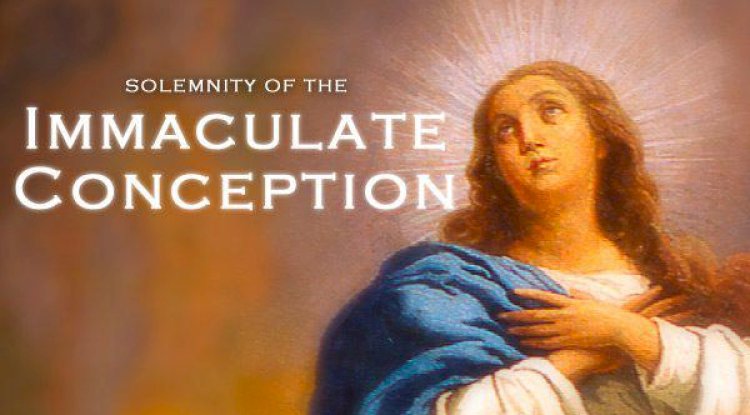
On December 8th, the Roman Catholic Church celebrates the Solemnity of the Immaculate Conception of the Blessed Virgin Mary. Her conception in the womb of St. Anna, like that of her Son, was announced to her parents by an angel of the Lord.
The story is recounted in the Protoevangelium of James:
And, behold, an angel of the Lord stood by, saying: Anna, Anna, the Lord has heard your prayer, and you shall conceive, and shall bring forth; and your seed shall be spoken of in all the world. And Anna said: As the Lord my God lives, if I beget either male or female, I will bring it as a gift to the Lord my God; and it shall minister to Him in holy things all the days of its life. And, behold, two angels came, saying to her: Behold, Joachim your husband is coming with his flocks. For an angel of the Lord went down to him, saying: Joachim, Joachim, the Lord God has heard your prayer. Go down hence; for, behold, your wife Anna shall conceive. And Joachim went down and called his shepherds, saying: Bring me hither ten she-lambs without spot or blemish, and they shall be for the Lord my God; and bring me twelve tender calves, and they shall be for the priests and the elders; and a hundred goats for all the people. And, behold, Joachim came with his flocks; and Anna stood by the gate, and saw Joachim coming, and she ran and hung upon his neck, saying: Now I know that the Lord God has blessed me exceedingly; for, behold the widow no longer a widow, and I the childless shall conceive.
Bl. Pope Pius IX officially proclaimed the Immaculate Conception a dogma of the Church in 1854 in the document entitled Ineffabilis Deus: “We declare, pronounce, and define that the doctrine which holds that the most Blessed Virgin Mary, in the first instance of her conception, by a singular grace and privilege granted by Almighty God, in view of the merits of Jesus Christ, the Savior of the human race, was preserved free from all stain of original sin, is a doctrine revealed by God and therefore to be believed firmly and constantly by all the faithful.”
Just because it hadn't been officially defined as a Marian dogma until 1854 does not mean that this was some 19th-century “invention” of the Church. In fact, in Ineffabilis Deus, the Holy Father points out that this truth is firmly supported by Scripture and was taught by the apostles and their successors:
This sublime and singular privilege of the Blessed Virgin, together with her most excellent innocence, purity, holiness and freedom from every stain of sin, as well as the unspeakable abundance and greatness of all heavenly graces, virtues and privileges — these the Fathers beheld in that ark of Noah, which was built by divine command and escaped entirely safe and sound from the common shipwreck of the whole world; in the ladder which Jacob saw reaching from the earth to heaven, by whose rungs the angels of God ascended and descended, and on whose top the Lord himself leaned in that bush which Moses saw in the holy place burning on all sides, which was not consumed or injured in any way but grew green and blossomed beautifully; in that impregnable tower before the enemy, from which hung a thousand bucklers and all the armor of the strong; in that garden enclosed on all sides, which cannot be violated or corrupted by any deceitful plots; as in that resplendent city of God, which has its foundations on the holy mountains; in that most august temple of God, which, radiant with divine splendors, is full of the glory of God; and in very many other biblical types of this kind. In such allusions, the Fathers taught that the exalted dignity of the Mother of God, her spotless innocence and her sanctity unstained by any fault, had been prophesied wonderfully.
One such Father was St. Andrew of Crete, who wrote in a homily on the Nativity of the Theotokos:
The unceasing power came quickly in help to those praying and beseeching God, and it made capable both the one and the other to producing and bearing a child. In such manner, from sterile and barren parents, as it were from irrigated trees, was borne for us a most glorious fruition -- the all-pure Virgin. The constraints of infertility were destroyed -- prayer, upright manner of life, these rendered them fruitful; the childless begat a Child, and the childless woman was made a happy mother. Thus, the immaculate Fruition issuing forth from the womb occurred from an infertile mother, and then the parents, in the first blossoming of Her growth, brought Her to the temple and dedicated Her to God.
As is the case with everything the Church teaches about Mary, ultimately her Immaculate Conception points us to Jesus. She was chosen from the whole human race to be the Mother of God, and as such was given - by the merits of her Son - this astounding grace: She is, indeed, full of grace. In bestowing this prevenient grace upon her, God had created a new pure and unblemished Ark of the Covenant in which he could dwell incarnate for nine months. How fitting that this seminal event would be commemorated in the season of Advent! As Dom Prosper Gueranger says, “Let us, then, celebrate this solemnity with joy; for the Conception of Mary tells us that the Birth of Jesus is not far off.”
O Mary, conceived without sin, pray for us who have recourse to thee!